


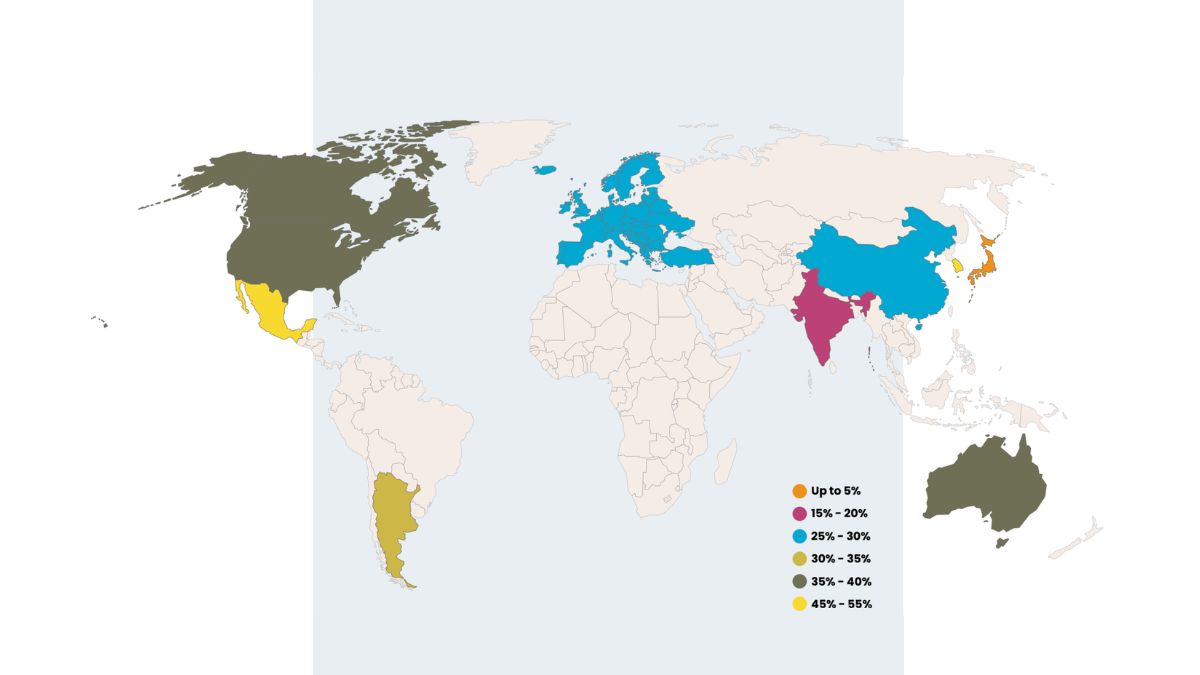
EUROPE
France, the United Kingdom, Germany, Italy, and Spain: in descending order by number of admissions, these are the five main European markets which, in the past year, recorded a total of 506 million admissions, marking a 6.5% decline compared to 2024, despite Germany’s positive result – the only market going against the trend (+2%).
A comparison with 2019 – not only a pre-pandemic year but also an exceptionally strong one – shows that about 29 out of every 100 cinema-goers have yet to return to theaters. The same figure applies to the other 24 European territories where MEDIA Salles recorded admissions in 2025.
This is a highly demanding challenge that has not yet been overcome, despite at least three years having passed since the end of Covid-related restrictions.
This challenge is not limited to Europe; it affects cinemas worldwide.
Let us therefore begin an overview of the main markets across different continents.
AUSTRALIA
Starting with Australia: closing the year with 54.2 million admissions, it recorded a 2.2% decrease compared to 2024, alongside an increase in box office revenue – measured in local currency – of roughly the same magnitude.
The gap compared to admissions in 2019 has thus widened to -36%.
SOUTH KOREA
The gap compared to 2019 has also increased in South Korea, where admissions declined again in 2025.
The nearly 14% drop compared to the previous year has led industry analysts to speak of a decline that may be difficult to reverse in a country that once had one of the highest per capita attendance rates in the world. In 2019, each resident purchased an average of 4.4 tickets; in 2025, only 2. As a result, 53% of pre-Covid audiences are still missing.
The decline in revenue is less pronounced, falling by about 5%, meaning that the average ticket price – again in local currency – has risen slightly, as also seen in Australia.
JAPAN
Japan recorded a remarkable increase in admissions in 2025 (+30.7%), bringing it close to the excellent 2019 result (only 3% of spectators still missing). Thanks to an average ticket price increase of about 8.5%, revenues surpassed those of that year, setting a new record (+5.1%).
CHINA
2025 was also a successful year for China, where admissions rose by 22.7% and revenues slightly less (+22.0%). This indicates that, unlike in other territories analyzed so far, the average ticket price experienced a slight decline.
However, despite the increase in attendance, the gap compared to 2019 remains significant: 28 out of 100 spectators are still missing.
INDIA
Remaining in Asia, India presents yet another scenario: admissions declined by nearly 6%, but the gap compared to 2019 is less pronounced at -19%.
THE AMERICAS
Across the Americas, the situation is highly varied: while North America (USA and Canada) recorded a slight increase in admissions in 2025 (+1% compared to 2024) and a more noticeable rise in gbo (+4.4%), Argentina and Mexico experienced sharper declines in attendance, down 6.6% and 14.3% respectively.
Despite these differences, all three markets share a significant gap compared to pre-pandemic attendance levels: Argentina is missing 30 out of every 100 spectators, North America 37, and Mexico as many as 46.
The global picture emerging from 2025 data reveals, on the one hand, marked heterogeneity across territories, and on the other, that the gap from pre-Covid attendance levels is still far from being closed.
FILMS
A look at the most successful films internationally confirms a trend toward concentration of audience interest on a relatively limited number of titles, such as Lilo & Stitch, How to Train Your Dragon, and Jurassic World: Rebirth, which generated around 60% of their total box office outside North America, or Mission: Impossible – The Final Reckoning and F1, for which international distribution accounted for as much as 70%.
In 2025, another recurring phenomenon – seen in both large and small territories – was the extraordinary appeal of domestic films, capable of attracting even occasional moviegoers. This trend was particularly evident in Asian markets.
Beyond the now almost legendary case of Ne Zha 2, the Chinese film that surpassed two billion dollars in box office revenue, Japan also saw films such as Demon Slayer: Infinity Castle and Chainsaw Man highlight the exceptional appeal of anime, while the ambitious Kokuho capitalized on the allure of kabuki theater, becoming a cultural phenomenon that attracted over 12 million viewers.
Similarly, the Indian box office benefited from the remarkable success of Dhurandhar, the Hindi-language film that achieved the highest global revenue of 2025.
In Latin America as well, domestic productions proved to be a strong draw, as demonstrated by the comedies Homo argentum and Mesa de regalos, the most successful national films in Argentina and Mexico respectively.
It is therefore not surprising that several observers of cinema consumption trends have begun to question whether Hollywood productions – often relying on proven but not particularly innovative formulas – are losing ground to films more deeply rooted in local sensibilities.