


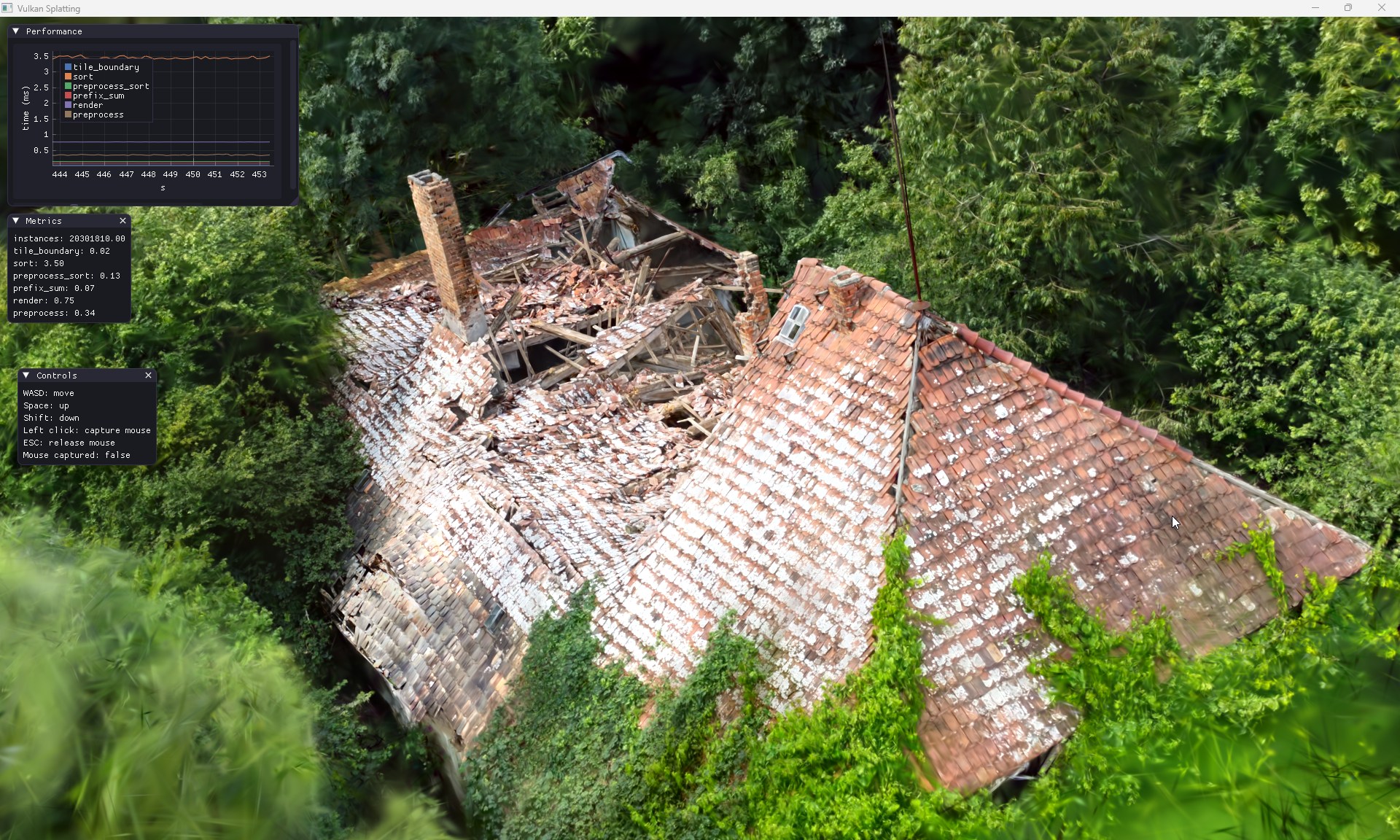
3D Gaussian Splatting (3DGS) is emerging as one of the most closely watched technologies in real-time 3D visualization, with potential applications across virtual production, VFX, XR, digital twins and location capture. Developed for novel-view synthesis, the technique can reconstruct a real-world scene from photographs or video and render it from different viewpoints with high visual fidelity and real-time performance.
Introduced at SIGGRAPH 2023 by Kerbl, Kopanas, Leimkühler, and Drettakis, 3D Gaussian Splatting offers an alternative to the implicit representations used by Neural Radiance Fields (NeRFs). Instead of relying on neural networks to describe a scene, it uses an explicit and highly parallelizable structure designed to take advantage of modern GPU rendering.
Unlike traditional polygonal meshes, the scene is represented as a collection of millions of anisotropic 3D Gaussians. Each primitive is defined by its position, scale, orientation — represented by a quaternion — opacity, and Spherical Harmonics coefficients, which model color as a function of the viewing direction. During optimization, these parameters are updated through a differentiable process to minimize the difference between the rendered images and the captured ones.
From 3D Gaussians to Screen-Space Splats
The crucial step takes place during rendering: the Gaussians are projected onto the image plane through an EWA (Elliptical Weighted Average) approximation, transforming them into 2D elliptical splats.
A tile-based differentiable rasterizer divides the screen into regions, sorts the primitives according to depth, and calculates the final color through front-to-back alpha blending. This approach avoids the costly ray marching typically used by NeRFs and makes efficient use of GPU parallelism, enabling real-time rendering that, under the specific conditions reported in the original paper, can exceed 100 FPS at 1080p.
An Approach Increasingly Integrated into 3D Workflows
The result combines high visual quality with real-time performance, making Gaussian Splatting particularly interesting for applications such as digital twins, XR, photogrammetry, geospatial visualization, and virtual production.
For the film, television and wider audiovisual industries, the growing adoption of 3D Gaussian Splatting could open new possibilities for capturing real locations, building virtual environments and integrating photorealistic assets into real-time production pipelines. Its combination of visual quality and rendering speed makes it particularly relevant as studios continue to explore more efficient workflows for virtual production, VFX, previsualization and immersive content.
The publication of the KHR_gaussian_splatting Release Candidate for glTF 2.0 by the Khronos Group in February 2026 also points toward greater standardization and interoperability. As tools and production pipelines continue to mature, 3D Gaussian Splatting is moving beyond experimental research and becoming a technology worth watching for companies working across the 3D and audiovisual production ecosystem.
Reference video: https://www.youtube.com/watch?v=T_kXY43VZnk