


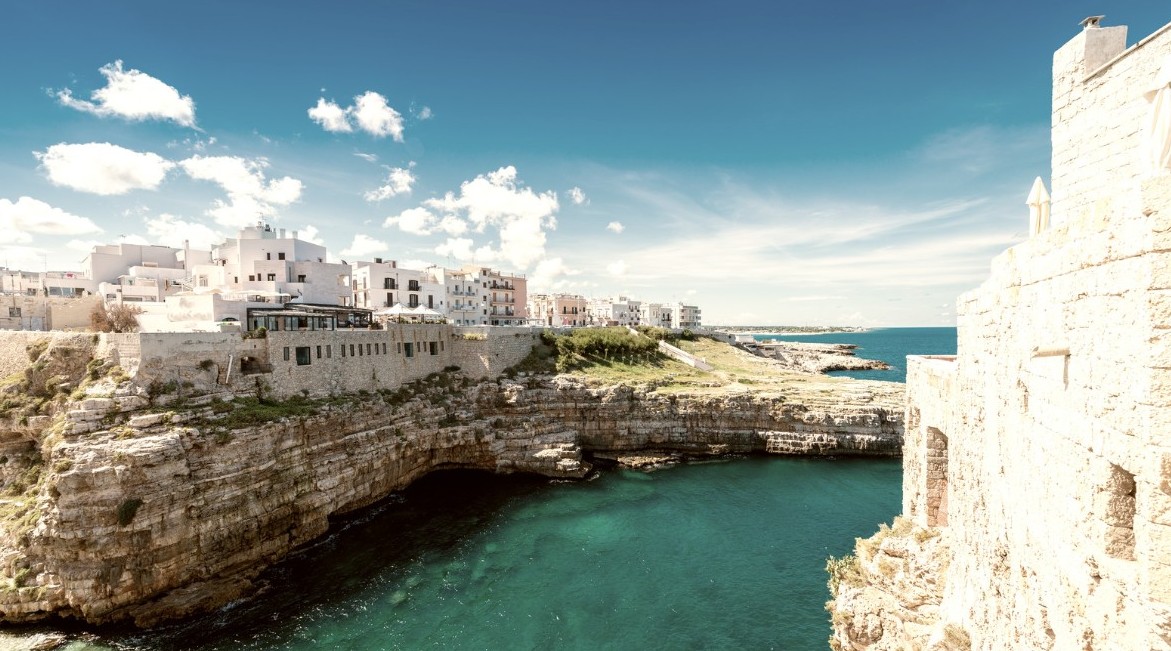
Shooting in Apulia gives film and television producers access to Mediterranean coastlines, historic cities, rural landscapes, experienced local crews and dedicated production facilities.
Located in southern Italy between the Adriatic and Ionian seas, the region offers settings ranging from baroque architecture and whitewashed villages to beaches, forests, ports and industrial environments.
For productions considering a feature film, television series, documentary, commercial or another audiovisual project, the Apulia Film Commission is the main institutional contact.
Support from the Apulia Film Commission
Established by the Region of Puglia, the Apulia Film Commission assists Italian and international productions preparing to work in the territory.
Its free services include preliminary location research, photographic scouting, introductions to local authorities and information about regional crews, suppliers, accommodation, transport and production facilities.
The Commission can help identify the authority responsible for a location, although filming permission must still be granted by the relevant municipality, public institution, heritage body or private owner.
Producers should make contact early, providing a synopsis, proposed schedule, location requirements, estimated crew size and any special technical needs.
Locations across the region
Apulia offers approximately 800 kilometres of coastline and a wide variety of urban, rural and natural settings.
Bari, the regional capital and largest city in Apulia, combines historic streets, modern neighbourhoods, a long seafront and active port environments. Nearby Polignano a Mare and Monopoli are smaller coastal towns known for their historic centres, cliffs, harbours and beaches.
The Valle d’Itria, a rural area in central Apulia, is recognised for its trulli, traditional masserie, olive groves and whitewashed towns. Its best-known destinations include Alberobello, Ostuni, Locorotondo and Cisternino, all of which are towns with distinctive historic architecture.
Lecce is a city in southern Apulia known for its baroque buildings and historic centre. It is also one of the main production bases for Salento, the peninsula forming the southernmost part of the region. The wider Salento area includes coastal towns, harbours and locations along both the Adriatic and Ionian seas.
The Gargano is a mountainous coastal area in northern Apulia offering forests, cliffs, caves, beaches and lakes. It includes locations around Vieste, a coastal town, and the Foresta Umbra, a protected forest within Gargano National Park.
Taranto is a major port city on the Ionian coast, combining a historic old town with maritime, archaeological and industrial environments.
Alta Murgia is an inland plateau and national park in central Apulia, characterised by open landscapes, rural roads and quarries. It is also home to Castel del Monte, a 13th-century castle and UNESCO World Heritage Site.
Finding local crews and suppliers
The Apulia Film Commission’s Production Guide helps incoming companies identify regional crew members, production businesses and technical suppliers.
It includes professionals working across production, direction, camera, lighting, sound, art departments, costume, makeup, locations, transport and post-production.
Access to some professional details may require the production to present an active project to the Film Commission.
Permits and special locations
Apulia does not have one filming permit covering the entire region. Permissions depend on the location owner, managing authority and activities planned.
Municipalities generally manage public streets and squares, while ports, museums, archaeological sites, protected environments, beaches and private properties may require separate authorisations.
Productions should provide detailed information about filming dates, working hours, vehicles, lighting, generators, road closures, drones, special effects and the possible impact on the location.
Drone operations must follow Italian and European aviation rules, while maritime filming may require approval from port authorities or Harbour Master’s Offices.
Production incentives and financing
Productions shooting in Apulia may be able to combine regional support with Italy’s national incentive for international audiovisual projects.
Under the most recently published Apulia Film Fund, qualifying productions could receive a contribution equal to 35% of eligible expenditure incurred in the region. This could rise to 40% for qualifying cross-border European productions and up to 60% for certain difficult works or eligible international co-productions. Maximum support varied according to the type of project, with higher limits available for television, animation and feature-film productions.
The €5 million Apulia Film Fund 2024 is now closed, so producers should contact the Apulia Film Commission to verify whether a new funding round is available before including regional support in their financing plan.
International productions may also qualify for Italy’s national tax credit for foreign audiovisual works. The incentive generally covers 40% of eligible production expenditure incurred in Italy, although a 30% rate applies to certain above-the-line costs involving non-European personnel. Applications must be submitted through an eligible Italian executive producer or production-service company.
Regional and national incentives may potentially be combined, subject to the rules, eligible-cost requirements and maximum state-aid limits applying to each project. Producers should therefore involve an experienced Italian production partner early and confirm available funding before finalising the budget and finance structure.
Preparing a production in Apulia
A production considering the region should begin by sending the Apulia Film Commission a clear project presentation, including the format, synopsis, proposed schedule and location brief.
The next steps should include identifying a local production partner, accessing the Production Guide, arranging a location scout and confirming which public or private bodies control each proposed setting.
Permits, insurance, employment rules, drone operations, road management, international cast and crew requirements and financial incentives should all be reviewed during pre-production rather than after locations have been selected.
With early planning, Apulia can provide both a visually diverse filming environment and a structured regional support network. Its combination of coastlines, historic architecture, rural landscapes, production hubs and experienced local professionals makes it a flexible destination for projects of different sizes and genres.
Official contact:
Apulia Film Commission: