

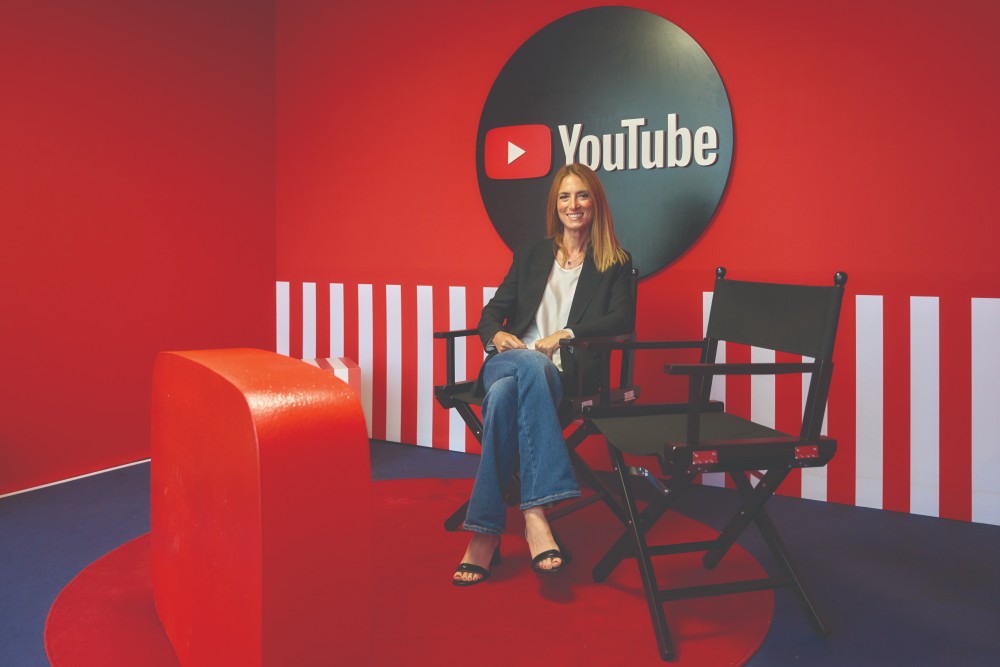
YouTube Southern Europe Director Francesca Mortari on generative AI, creativity, and why technology can open new career paths.
Think of Janus, the two-faced Roman god: looking forward while remaining firmly connected to its roots, riding the wave of artificial intelligence without abandoning tradition. That, in a nutshell, was one of the takeaways from the latest edition of the Venice Film Festival, which provided the setting for an unprecedented partnership between the Biennale (the organization behind the Festival) and Google/YouTube.
The collaboration included three days of meetings, events and announcements at the striking Google Beach, marking Google’s first appearance as a sponsor of the historic festival.
“We’ve been working with the film industry for a long time. When two organizations are in constant dialogue, it’s only natural for that relationship to grow closer,” explained Francesca Mortari, YouTube Director for Southern Europe. “Especially when they share a common goal: developing the creative ecosystem. Following our presence at the Milano Film Festival and now Venice, we want to keep that conversation going. We’re confident this will be the beginning of a long-lasting partnership.”
The partnership between the Biennale and Google/YouTube marks something of a turning point: a “peaceful invasion” of one of cinema’s most traditional spaces by the digital world. According to Mortari, however, the relationship developed organically.
“YouTube plays a key role in the creative industry. And when we talk about the creative industry, cinema inevitably has to be part of the conversation. The connection between YouTube’s digital world and the traditional world of the seventh art was inevitable. And, of course, we have to talk about artificial intelligence, which in this particular context can amplify the creativity of our content creators.”
Google/YouTube’s debut among the Biennale’s sponsors is intended precisely to support this creative ecosystem, bringing cinema and digital media closer together while also addressing resistance to the use of generative AI with data.
In a survey conducted by Public First for Google in 2025—which measured businesses’ views on AI, their use of it, and their plans to adopt it— researchers surveyed 2,348 businesses across 15 European markets: Belgium, the Czech Republic, Denmark, Finland, France, Germany, Greece, Ireland, Italy, the Netherlands, Norway, Poland, Romania, Spain and Sweden. For Mortari, the study’s most interesting finding concerns “AI’s ability to bring Italian content to international audiences. Italian cinema will no longer be constrained by borders because, thanks to AI and simultaneous translation, the visibility of Italian cultural content will increase by 540%, with an additional economic impact of around €2 billion.”
After all, universality is at the heart of YouTube’s identity. The platform’s mission is “to give anyone, anywhere in the world, the opportunity to tell their story. YouTube is the world’s largest digital stage. It gave rise to the creator economy, and without creators, the platform would not be what it is today.”
Cinema has also made extensive use of that stage, with a large number of movies now available on demand, either free or for a fee. But Mortari ruled out the possibility of YouTube moving into traditional film production, following the path taken by Netflix, Amazon and Apple.
“Our business model does not include traditional production. We support creators through our platform and the tools we make available to them. In Venice, we presented two very important stories: The Last Day of Ramadan by theShow, which explores fasting in Italy and Morocco, and The Mad Honey of the Himalayas by Lati Umani, another original story revealing the existence of hallucinogenic honey in the Himalayas.” These stories originate from human creativity, but their development and reach are being supported by the implementation of generative AI on a platform that continues to evolve.
And for those concerned about the potentially negative impact of artificial intelligence on employment, Mortari adds: “There will be different kinds of jobs, jobs we can’t even imagine today. The same thing has happened in the past: many jobs that are completely ordinary today simply didn’t exist in 1945. I firmly believe that tomorrow we’ll have the same opportunities for growth that we have experienced in the past, growth that has had a major impact on people’s lives and on the economy. I’m optimistic. I believe AI will help us find new career paths.”
Read more: Cinema & Video International Issue #209