

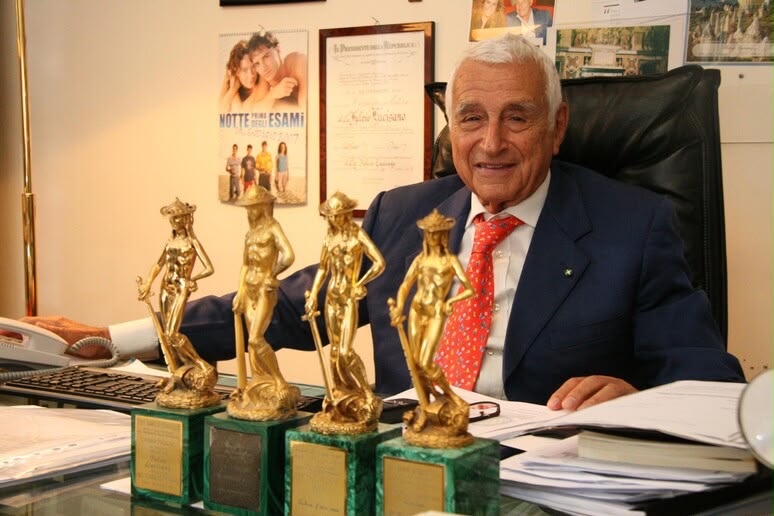
Fulvio Lucisano, one of the last direct witnesses to the birth of modern Italian cinema, died on August 18 in Rome at the age of 98. His daughter Paola confirmed the news to the Italian news agency ANSA with a brief statement: “Rest in peace, Dad.”
Born in Rome on August 1, 1928, to a Calabrian father from Villa San Giovanni, Lucisano belonged to the generation that watched Italy torn apart by war and rebuilt from its ashes. He earned a law degree from Sapienza University, but cinema, not the courtroom, was always where he wanted to work.
His career started in 1949, when he took part in a documentary on the Jubilee Holy Year, followed by newsreel work for Istituto Luce aimed at Italian communities in the Americas. Hundreds of documentaries followed under his own outfit, Documento Film, before he moved into fiction filmmaking with his first production, I quattro del getto tornante (1955).
In 1958, just three years after that debut, Lucisano founded Italian International Film (IIF), the company he would still preside over nearly seventy years later, and which later grew into the publicly listed Lucisano Media Group. Over more than 150 productions, IIF became one of Italy’s most durable and prolific studios, a rare survivor across the eras of ticket queues, commercial television and, more recently, streaming.
From Cult B-Movies to Box-Office Comedy: A Filmography Without Borders
Lucisano’s filmography resists any single label. In the 1960s he worked closely with American genre producers such as Roger Corman and Samuel Arkoff, mounting cult titles like Mario Bava‘s science-fiction classic Planet of the Vampires (1965) and the giallo What Have You Done to Solange? (1972), alongside curiosities such as War, Italian Style (1965) starring Buster Keaton and Franco Zeffirelli’s Young Toscanini (1988) starring Elizabeth Taylor.
He worked with an extraordinary range of directors and stars over the decades, from Luigi Comencini, Lina Wertmüller, Damiano Damiani, Mauro Bolognini and Francesca Archibugi to Alberto Sordi, Paolo Villaggio, Franco Franchi and Ciccio Ingrassia — and, above all, Massimo Troisi, whom Lucisano spotted performing at Rome’s Teatro Tenda in the late 1970s and convinced to direct himself in I’m Starting from Three (1981), one of Italian comedy’s defining hits.
The list of titles he produced runs from Tre Tigri Contro Tre Tigri (1977) and Il Ras del Quartiere (1983) to Fantozzi – Il Ritorno (1996) and Nght Before the Exams (2006), spanning comedy, drama and genre cinema across more than 130 features bearing his name as producer.
His Calabrian roots, tied to his father’s hometown of Villa San Giovanni, surfaced repeatedly in his work, most explicitly in Luigi Comencini’s A Boy from Calabria (1987) and in Aspromonte: Land of the Forgotten (2019), a nostalgic, fable-like tribute to his origins made with director Mimmo Calopresti.
Institutional Recognition and Industry Leadership
Beyond the credits, Lucisano was also a builder of industry infrastructure. Starting in the 1990s, together with producer Aurelio De Laurentiis, IIF developed a chain of multiplex cinemas in Rome, and the company expanded into television production in the 2000s. Lucisano also served as president of ANICA, Italy’s national film industry association, from 1998 to 2001.
Honors followed accordingly. In October 2007, President Giorgio Napolitano named him Cavaliere del Lavoro. In 2009, the David di Donatello Awards recognized his fifty-year career with a lifetime achievement prize — one of five David di Donatello he received over the years, alongside four Nastri d’Argento. In 2005, the Venice Film Festival paid tribute to his career, and in 2019 the Magna Grecia Foundation awarded him a Special Lifetime Achievement Award, praising him “for having told through his films the story of Italy, a country marked by contradictions but also by passion and creative genius.”
Following the news of his death and pointing to his passion, intuition and talent for spotting talent others had missed, Italy’s Culture Minister Alessandro Giuli hailed Lucisano as
“one of the great architects of Italian cinema”
A Family Legacy and a Final Word on Cinema
Lucisano’s work continues through his daughters, Federica and Paola, both producers in their own right. Federica has led the Lucisano Media Group in recent years, while Paola has focused on the company’s television output — a succession that turned what began as one man’s postwar gamble into a family business now in its third generation of leadership.
In one of his last major interviews, given in June 2020 alongside Federica during the pandemic’s darkest months for the film industry, Lucisano did not sugarcoat the moment: “There’s no doubt about it: as far as I can remember, this is the most difficult time the film industry has ever faced,” he said — but he closed with a line that reads today like his own epitaph: “Cinema will suffer just as the theatre has suffered. But people will continue to go to the cinema. The cinema is irreplaceable.”
With his death, Italian cinema loses one of its last direct links to the postwar generation that rebuilt the country’s film industry from nothing — a producer who, across seventy years and three eras of the business, never stopped betting his own money, and his own name, on a good story.
Continue reading: Romanian Cinema Builds Momentum as Florin Șerban Wins Locarno’s Pardo d’Oro