


Italy’s audiovisual industry continued to expand in 2025, reaching a total value of €16.8 billion. However, the pace of growth moderated significantly, with a 3.1% year-on-year increase, compared with the 9% growth registered in 2024.
The strongest momentum came from online video services, which continued to reshape the market. Free online video services recorded 15% growth, while paid services expanded by 10.3%. A similar performance is expected for 2026, confirming the growing importance of digital distribution.
The industry’s expansion is also reflected in employment figures, with 128,336 people involved in audiovisual activities in 2026, representing a 3.3% increase compared with 2024.
Yet the positive figures conceal a slowdown in production spending. For the first time since 2018, investment in content for cinema, television and video-on-demand (VoD) declined, falling 7.4% to €2 billion in 2025. The contraction was particularly evident in scripted TV and VoD productions, which lost €122 million in investment. Fiction production accounted for €740 million, down 5.5%, a reversal from the average annual growth rate of 7.7% recorded between 2018 and 2025.
The main factor affecting the sector’s resilience is uncertainty surrounding the public funding framework, from the amount of available resources to eligibility criteria and application timelines. This situation hampers producers’ ability to plan ahead, increases financing costs and reduces margins, placing pressure on all companies, particularly smaller businesses, with consequences for liquidity and investment capacity.
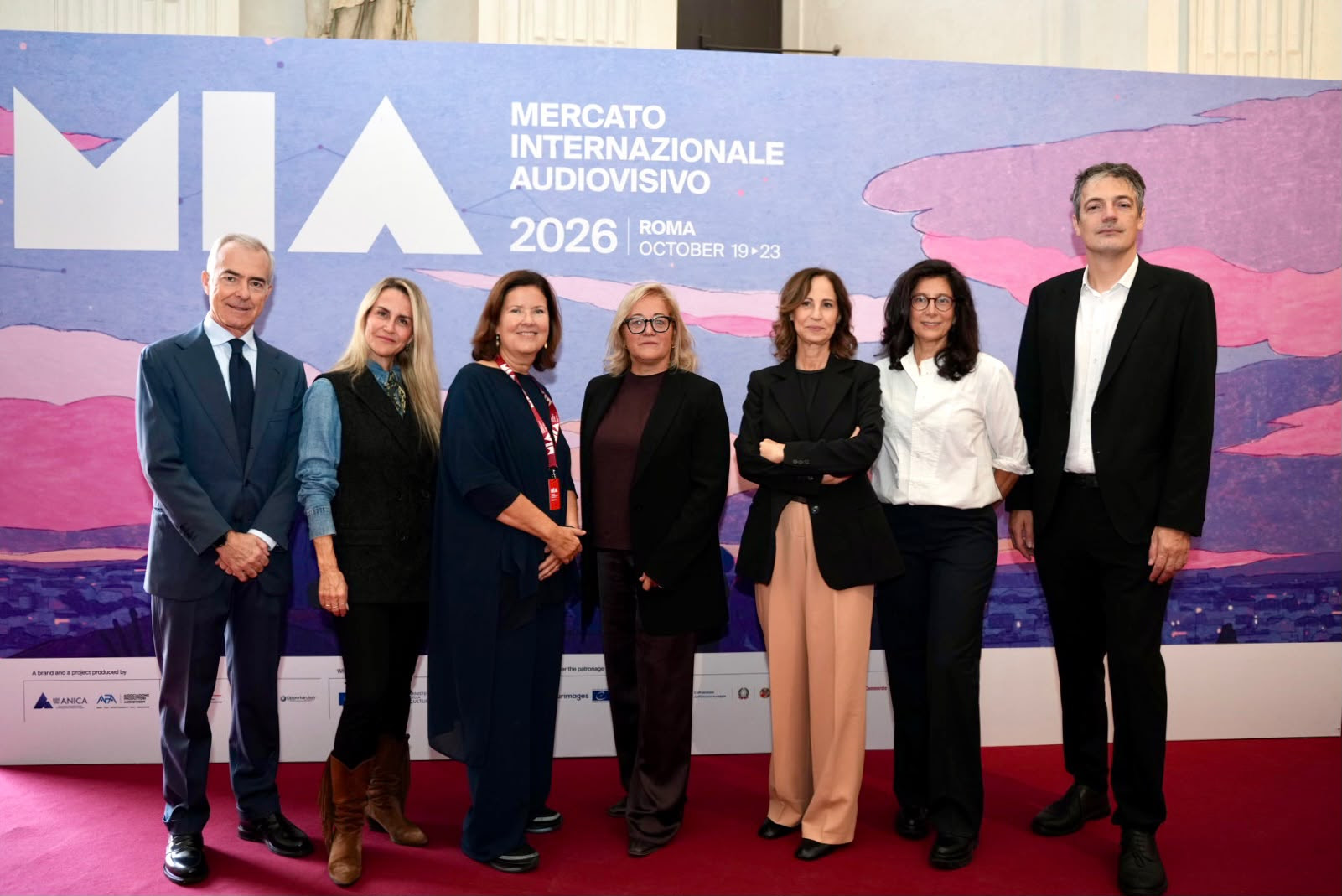
These are the key findings of the 8th Report on National Audiovisual Production by APA, which brings together research by CeRTA–Università Cattolica, eMedia, Fondazione Symbola and OpenEconomics. The report was presented by APA President Chiara Sbarigia at Palazzo Barberini as part of MIA | Mercato Internazionale Audiovisivo.
Streaming Growth Reshapes Italy’s Audiovisual Market
The data presented by APA also highlighted the sector’s profound transformation, with the market share of linear television, both free-to-air and pay-TV, progressively declining as global platforms continue to grow. Online video accounted for 21% of the market in 2020 and now represents 43%. In the short to medium term, it is expected to surpass linear television in value.
In television, unscripted content remains the backbone of broadcasters’ schedules, with more than 17,000 hours of original first-run programming. Independent production accounts for 59% of titles.
Streaming platforms are also expanding their offerings, with content up 51% and total hours up 30%. Factual programming is the fastest-growing genre, with viewing hours increasing by 36%, while the number of factual titles adapted from international formats has doubled. Game shows are gaining ground on general-interest channels, particularly in access prime time and prime time.
“Established titles produced by independent companies continue to deliver value to broadcasters,”
said APA President Chiara Sbarigia. “For example, Stasera tutto è possibile (Endemol Shine) generates an additional 11.8 percentage points in prime-time audience share for Rai2.”
Original scripted production is also growing in terms of the number of titles, with 101 titles in the season, up 9%. Growth is driven by linear broadcasters, which account for 74 titles, while streaming platforms have stabilised at 27 titles, with SVOD recording growth of 5%.
Italian Fiction Expands Its Reach as New Formats Emerge
The report shows that Italian fiction continues to reach large and diverse audiences. On linear television, Sandokan (Lux Vide) and La preside (BiBiFilm) both attracted average audiences of more than 4.6 million viewers. In the digital space, Mare Fuori (Picomedia) exceeded 2.1 billion minutes viewed, while Il paradiso delle signore reached 2 billion minutes (Aurora TV). On Netflix, Il Mostro (The Apartment) recorded 9.7 million global views in its first week.
“Original Italian fiction also continues to showcase a diversity of locations and regions, thanks in part to the excellent work of our Film Commissions, in every respect, not least in promoting tourism,”
said Sbarigia. “In the face of AI and the spread of low-cost synthetic content, ‘Made by Humans’ is becoming a genuine premium of authenticity. Human creative and artistic contributions are set to become increasingly valuable, particularly in productions with strong editorial oversight.”
Lazio remains the region most frequently represented in Italian stories, accounting for approximately one title in five. Examples range from Rome, featured in Un professore (Banijay Studios), I Cesaroni – Il ritorno (Publispei), Call My Agent – Italia (Palomar) and Mrs Playmen (Aurora TV), to Lake Bracciano, the setting for Buongiorno, mamma! (Lux Vide) and A testa alta – Il coraggio di una donna (Banijay Italia). Lazio’s central role in storytelling is also reflected in its industrial and employment contribution: according to estimates by Fondazione Symbola for APA, the region accounts for 40.6% of national employment in the core audiovisual industry.
In terms of formats, the APA report examines for the first time the phenomenon of “Microdramas”, a new frontier in entertainment based on vertical video formats that reflect contemporary patterns of smartphone content consumption.
“We wanted to analyse the phenomenon of vertical storytelling, which has reached a global market worth €14 billion in a very short time,” Sbarigia explained. The report highlights that, in Italy, ReelShort, DramaBox, NetShort and DramaWave are already among the country’s top 15 entertainment apps by consumer spending. Notably, the first original Italian production in this format has already been released: Tutto in una notte (Fascino PGT), comprising 54 episodes distributed through WittyTV and social media.
Following the presentation of the findings at Palazzo Barberini, a discussion was held on creativity as a decisive driver of the audiovisual sector, bringing together Chiara Sbarigia, President of the producers’ association, and leading industry figures: Maria Pia Ammirati (Director, Rai Fiction); Eleonora Andreatta (Vice President, Italian Content, Netflix); Laura Carafoli (Head of Content, Southern Europe, Skydance Networks); Giampaolo Letta (Deputy General Manager for Fiction and Cinema at RTI SpA – Mediaset Group, and CEO of Medusa Film); Emanuele Marchesi (Director, Sky Studios Italy); and Nicole Morganti (Head of Local Originals, Southern Europe, Amazon Studios). The discussion was moderated by Massimo Scaglioni, Director of CeRTA.
Read more: New Fund for Italian Film and TV Production Unveiled at MIA 2026